Corporate Finance in South Africa
Key Takeaways
- Corporate finance covers funding strategy, capital structure, business valuation and strategic transactions, all shaped by South Africa’s regulatory environment, including the Companies Act 71 of 2008, the Competition Act 89 of 1998 and B-BBEE legislation.
- Deal activity concentrates in renewable energy, fintech, healthcare, logistics and mining.
- Successful transactions, whether M&A, management buyouts or BEE ownership deals, depend on defensible valuation and a financing structure that balances debt and equity.
- Futshane provides technology-enabled corporate finance advisory to South African mid-market and growth businesses, with regulatory compliance built in from the start.
- This practical guide is aimed at SA business owners, shareholders, and management teams considering strategic transactions.
Introduction
For South African business owners, corporate finance decisions shape the trajectory of their companies. Whether you’re raising growth capital, selling a family business built over decades, or implementing a BEE transaction to strengthen your scorecard, these moments define long-term value creation.
Corporate finance is fundamentally about how a business plans, sources, invests, and returns capital to shareholders. It’s the discipline of making financial decisions that maximise enterprise value while ensuring the company remains solvent and liquid. In South Africa, this work also requires navigating exchange-rate volatility, load-shedding risks, policy uncertainty, and local empowerment requirements.
This article covers the definition of corporate finance, the SA regulatory landscape, common transaction types, valuation methods, capital structure and working capital management, and Futshane’s approach to advisory services. The content is written from Futshane’s perspective as a specialist South African corporate finance advisory firm focused on mid-market transactions.
What is Corporate Finance?
Corporate finance is the discipline focused on how companies raise capital, allocate it to projects, manage risk and cash flows, and return funds to shareholders to maximise enterprise value. It sits at the intersection of financial management, corporate strategy, and business decisions that determine a company’s future. In corporate finance, there is a strong focus on cash flow, prioritising liquidity and measuring value by cash flows rather than accounting profit.
The three classic decision areas are:
| Decision Area | Key Question | Example |
| Investment decisions | Which projects or acquisitions should we pursue? | A Johannesburg manufacturing firm considering a R50m investment in new plant equipment |
| Financing decisions | How do we fund these investments with debt, equity, or hybrids? | Choosing between bank loans, diluting equity capital or mezzanine funding |
| Dividend/distribution decisions | How much do we return to shareholders versus reinvesting? | Balancing retention for growth against dividend policy obligations |
Consider a practical example: a Gauteng-based manufacturer assessing a R50m capital investment in the future, say the year 2030. This involves capital budgeting (will the project generate returns above the hurdle rate?), funding choice (debt financing versus equity?), and dividend impact (can we still meet shareholder distributions?).
Corporate finance differs from accounting in its forward-looking orientation. While accounting focuses on historical reporting, corporate finance emphasises projecting future cash flows, conducting scenario analysis, and making business decisions that create shareholder value. Finance professionals use tools like net present value, internal rate of return and financial modelling to evaluate various scenarios.
Scenario analysis is a key part of risk management in corporate finance. It includes evaluating worst case outcomes to assess risk and prepare for adverse conditions. Financial modelling helps businesses anticipate market volatility and implement risk mitigation strategies such as hedging or diversification. Investment appraisal employs tools like Net Present Value (NPV), Internal Rate of Return (IRR), and Payback Period to evaluate project profitability. The time value of money (TVM) is a key principle, stating that money available today is worth more than the same amount in the future due to its earning capacity.
For readers seeking technical depth on formulas for NPV, WACC, or CAPM, see our supporting guide on valuation methods.
The Corporate Finance Landscape in South Africa
South African corporate finance is shaped by local legislation, sector dynamics, and macroeconomic challenges that distinguish it from global markets. Deal activity tends to concentrate in specific industries, and transactions must navigate a complex regulatory environment.
Key Sectors Driving Deal Flow
| Sector | Deal Drivers | Notable Activity |
| Renewable Energy | REIPPPP projects, Just Energy Transition | Successive public procurement rounds and private power purchase agreements |
| Fintech/Financial Services | Digital banking growth | Digital banking and payments growth attracting acquirers and investors |
| Healthcare | Post-COVID expansions | Private equity inflows into hospital consolidations |
| Logistics | Port reforms, e-commerce boom | Port and rail reform opening private participation |
| Mining/Resources | Commodity supercycles, EV battery demand | Platinum/PGM mergers and acquisitions |
| Consumer/Retail | Market consolidation | Strategic acquisitions by large corporates |
Regulatory Framework
The Companies Act 71 of 2008 governs fundamental transactions. A disposal of all or the greater part of a company’s assets or undertaking, meaning more than 50% of its gross assets fairly valued, requires a special resolution, as do schemes of arrangement. Directors remain bound by the duties of care, skill and good faith under section 76.
The Competition Act 89 of 1998 requires mergers above certain turnover or asset thresholds to be notified to the Competition Commission before they are implemented. The practical point is simple: if your transaction is large enough to be notifiable, build the Commission’s process and timeline into your deal plan, because implementing without approval carries penalties.
Broad-Based Black Economic Empowerment (B-BBEE) is central to corporate finance in South Africa. The B-BBEE Act 53 of 2003 and Codes of Good Practice set ownership targets of 25% plus one vote of voting rights and 25% economic interest. Common structures include vendor-financed SPVs, employee share ownership plans (ESOPs), and preference shares. Non-compliance can exclude companies from state contracts, with the indirect consequence of being an unattractive supplier where your customers have contracts with the state.
Exchange-control considerations through the South African Reserve Bank’s Financial Surveillance Department may apply to cross-border deals, particularly when local companies are acquired by foreign buyers or when SA shareholders invest offshore. Approvals remain necessary for significant transactions.

Corporate Finance Transactions
Corporate finance transactions range from full business sales and acquisitions to targeted BEE ownership deals and internal restructurings. Each transaction type serves different strategic objectives and involves distinct processes.
Mergers and Acquisitions (M&A)
A typical sale or acquisition of a private SA business follows this process:
- Initial approach and NDA (1–2 weeks): Confidentiality agreements and preliminary discussions to establish trust and legitimacy
- Information memorandum and teaser (4–12 weeks): Packaging the transaction to ensure it is ready for sale or funding. This typically includes preparing materials show such as business plans, feasibility studies and the value story
- Indicative offers and heads of agreement (4–8 weeks): Non-binding and then binding terms
- Due diligence (2 –6 weeks): Financial, legal, and tax review
- Sale and Purchase Agreement (SPA) (4–8 weeks): Execution of legal documents, warranties and indemnities
- Closing: Regulatory approvals, Competition Commission clearance, funds transfer and conditions precedent
Throughout each stage, the lead partner is actively involved, ensuring continuous engagement and commitment to understanding and meeting the client’s needs.
Owners typically consider M&A for succession planning , strategic growth, or accessing new capital.
Management Buyouts (MBOs) and Buy-Ins (MBIs)
In an MBO, management teams acquire the business they run, usually funded through a combination of debt and equity. In our experience the typical structure combines:
- Debt of 40% to 60% of the funding, through vendor loans and mezzanine finance
- Equity from private equity funds with defined return hurdles
- Management investment of personal resources
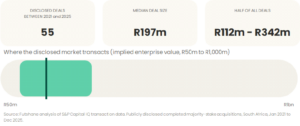
Our analysis of publicly disclosed transactions shows 55 majority-stake acquisitions of South African companies with enterprise values between R50 million and R1 billion across the five years 2021 to 2025, at a median value of about R200 million. Disclosed deals usually involve a listed party, and private-to-private sales are rarely announced, so the actual market is larger than the public record. MBOs are an established succession route in this range, allowing founders to exit while preserving company culture and management continuity.
Acquisitions and Disposals of Divisions or Assets
Partial transactions involve selling non-core subsidiaries or acquiring complementary business lines. Property portfolio carve-outs at NAV plus premium and strategic bolt-on acquisitions are typical examples. SPA provisions around net debt and working capital pegs prevent manipulation at closing.
BEE Transactions
BEE transactions are typically structured to meet the ownership targets in the codes. Common structures include:
- A sale of shares with part of the price deferred and funded from future dividends
- Preference shares with a fixed dividend and participation features
- ESOPs giving employees a broad-based stake that vests over time
These transactions are often timed around annual scorecard verification cycles.
Other Transactions
Capital raisings include private placements, rights issues for listed companies and recapitalisations that convert debt to equity in distressed situations. Refinancing transactions reset pricing, covenants and tenor as market conditions change.

Business Valuation
Valuation underpins every corporate finance transaction. Whether for shareholder buyouts, SARS-related assessments, or BEE deal pricing, a defensible fair value is essential. In South Africa, independent valuations are often required for regulatory, tax, or governance purposes.
Discounted Cash Flow (DCF)
The DCF method projects free cash flows, a forecast period, typically between 5–10 years and calculates net present value using a discount rate, normally the WACC.
Assumptions for a DCF may vary, but these are the most common inputs include:
- Cashflow projections
- Capital expenditure and working capital changes projections
- Terminal value
- Cost of equity
- Cost of debt
- Taxes
Market-Based Methods
This method uses multiples of publicly traded company, for example JSE-listed companies or recent transactions to value a company. One needs to be careful to select the appropriate multiple, based on the information available and industry. Once multiple is selected, appropriate adjustments through premiums and discounts are applied to arrive at the multiple to be used in the valuation. Multiples that reference EBITDA, EV and P/E are commonplace in valuations and seem to be preferred by valuation professionals.
Asset-Based Methods
Net asset value (NAV) and adjusted NAV methods are particularly relevant for property companies, investment holding entities, and capital-intensive businesses. The calculation involves assets at market value minus liabilities, with adjustments for intangible assets where appropriate.
When Independent Valuation is Required
- Shareholder disputes requiring court-ordered appraisal
- Section 114/115 transactions under the Companies Act
- IFRS 3 business combinations and fair value reporting
- Employee share schemes and BEE ownership deals
- Capital gains tax (CGT) assessments
Sensitivity analysis is critical in SA valuations. Testing different growth rates, discount rates, and currency stress scenarios ensures robust conclusions.
Capital Structure and Working Capital
Capital structure (long-term funding mix) and working capital management (short-term liquidity) must work together to support transactions and ongoing operations. Getting this balance right determines whether a business can pursue capital investments while maintaining a healthy cash balance.
Debt Versus Equity in South Africa
Common funding instruments for mid-market deals include:
| Instrument | Typical Terms | Use Case |
| Bank term loans | 3–10 years, interest rate linked to prime | Asset backed financing or acquisitions |
| Mezzanine finance | Bespoke pricing, depends on the risk of the instrument. | Bridge financing, LBO structures |
| Preference shares | Preferred shares can be structured in various ways to meet the needs of both the issuer and the investor. The key would be redemption and dividends | BEE transactions, LBO structures |
| Private equity | IRR hurdles, dividend policy | Growth capital, MBO |
| Shareholder loans | Subordinated, flexible terms | Family business funding or owner managed businesses |
Trade-Offs of Leverage
Higher leverage amplifies returns through the debt tax shield, at 27% corporate rate, but increases financial risk and covenant pressure. A case in point is that in South Africa the repo rate fluctuates based on economic indicators, particularly CPI. Should interest rates rise, the impact on borrowing costs, can cause a breach of debt covenants. These covenants often reference solvency and liquidity. The typical ones are interest cover and debt service cover ratio. For example, if your debt service cover ratio (DSCR) is set at a minimum of 1.5X and at transaction close your forecasts show that you will achieve a DSCR of 1.8x, then when interest rates rise significantly, without any changes in your business circumstances, you may find yourself dipping below the 1.5X and therefore breaching the covenant.
An optimal capital structure aims for sufficient borrowed capital to be tax-efficient while maintaining enough equity and headroom to navigate shocks. Post-COVID deleveraging across SA mid-market businesses demonstrated the importance of financial flexibility.
Working Capital in Transactions
Working capital, generally, comprising current assets minus current liabilities. Transaction agreements peg normalised working capital levels to prevent manipulation. This area requires sound judgement and industry knowledge or research.
Practical improvements before a deal:
- Tighten debtor collection to days sales outstanding below 60
- Rationalise inventory to achieve turns that are acceptable to your industry
- Renegotiate creditor terms beyond 90 days where relationship permits
Financial Planning in Corporate Finance
Financial planning forms the backbone of effective corporate finance, enabling South African companies to make strategic business decisions that drive long-term value. At its core, financial planning involves a deep understanding of how capital investments, cash flows, and the cost of capital interact to influence shareholder value. Finance professionals rely on robust financial modelling and net present value (NPV) calculations to evaluate various scenarios, ensuring that each investment or financing decision aligns with the company’s objectives and risk appetite.
In practice, financial planning means forecasting future cash flows, assessing the viability of capital projects, and determining the optimal capital structure to support growth while maintaining financial stability. For South African businesses, this process must also account for the unique regulatory landscape, including black economic empowerment (BEE) requirements, which can influence both access to capital and strategic direction.
An engineering business lands its largest order yet, and growth starts consuming cash faster than profit comes in, because materials and wages are paid months before the customer pays. The simple instrument is a working capital facility sized off the order book, supported by a monthly cash flow forecast the bank can test. The practical considerations: the bank will want the debtors book ceded as security, the order must still be profitable after funding costs, and the forecast must show the facility paying down between orders rather than becoming permanent debt.
Dividend Policy in South African Corporates
Dividend policy is a key element of corporate finance for South African companies, directly impacting how excess cash is distributed to shareholders and how the business balances growth with rewarding investors. Finance professionals must carefully consider the company’s stage of development, industry standards, and overall corporate strategy when advising on dividend policy. For example, a mature company with stable cash flows may prioritise regular dividend payments, while a high-growth business might retain more earnings to fund future capital investments.
In South Africa, dividend payments are governed by the Companies Act, which sets out the legal framework for declaring and paying dividends. This ensures that companies only distribute dividends when they have sufficient profits and liquidity, protecting the business and by extension, its shareholders. Financing decisions, such as raising new equity or taking on debt, also influence dividend policy, as companies must ensure they maintain enough cash to meet obligations and support ongoing operations.
A cyclical, owner-managed business, construction or commodity-linked, has a record year and the shareholders want a record dividend. The simple instrument is a two-part policy: a modest base dividend the company can sustain in a weak year, plus a special dividend declared only once the year-end results, next year’s capital expenditure and a cash buffer are known. The practical considerations: the board must pass the Companies Act solvency and liquidity test before declaring, dividends tax of 20% applies to the shareholders, and bank covenants should be re-tested after the payment, because the cycle that produced the record year will eventually produce the opposite.
Risk Management in Corporate Finance
Risk management is an essential pillar of corporate finance, empowering South African companies to safeguard their assets and ensure business continuity in the face of uncertainty. Effective risk management involves identifying, assessing, and mitigating a wide range of risks (including market volatility, credit exposures and operational disruptions) that could impact financial performance.
Companies employ a variety of strategies to manage risk, from implementing robust internal controls to using financial instruments such as derivatives to hedge against adverse movements in interest rates or currency values. In the South African context, adherence to frameworks like the King IV Report on Corporate Governance is crucial, as it sets out best practices for risk oversight and management at the board and executive levels.
The founder is approaching retirement and is still the business, holding the customer relationships and the pricing knowledge. Two simple instruments deal with the hard edge of that risk: key person insurance, which gives the company cash to survive a sudden loss, and a buy-and-sell agreement between shareholders, funded by life cover, so a retiring or deceased shareholder’s stake changes hands at an agreed price instead of in a dispute. The practical considerations: both depend on a defensible valuation that is updated as the business grows, and the agreement must match the shareholders agreement and the MOI, otherwise the paperwork contradicts itself exactly when it is needed.
The Impact of Interest Rates on Corporate Finance
Interest rates play a pivotal role in shaping corporate finance decisions for South African companies, influencing everything from the cost of debt to the valuation of investments. When interest rates rise, borrowing becomes more expensive, affecting cash flows and prompting companies to reassess their capital structure and financing decisions. Conversely, lower interest rates can make debt financing more attractive relative to equity, potentially altering the balance between borrowed and owned capital.
Finance professionals must closely monitor interest rate trends and their impact on the company’s financial performance, particularly in a market where rates can be volatile. Changes in interest rates affect not only the direct cost of bank loans and other debt instruments but also the discount rates used in investment appraisal and business valuation. This, in turn, influences decisions about capital investments, dividend payments, and overall corporate strategy.
A business funds an acquisition or expansion with a five-year term loan priced off prime, and the budget only works at today’s rate. The simple instruments are to fix the rate on a portion of the loan, or to buy an interest rate cap that sets a ceiling while keeping the benefit if rates fall. The practical considerations: fixing carries a premium over the floating rate, so most businesses fix part of the loan rather than all of it, and the protection should run for the heavy repayment years, not just the first twelve months. On a R30 million loan, two points of prime is R600,000 a year, usually far more than the protection costs.
How Futshane Approaches Corporate Finance
Futshane is a technology-enabled South African corporate finance advisory firm focused on owner-managed, mid-market and growth companies. We simplify complex transactions, from strategic review through to close. Our professionals are globally aware and accessible, and we advise clients across South Africa and into the rest of Africa where the transaction requires it. Sectors include investments, healthcare, mining and energy, financial services, and technology and communications.
Client Profile
Typical clients include:
- Businesses with enterprise values between R50m–R1bn
- Family-owned or owner managed companies planning second or third-generation succession
- Family offices
- BEE investors establishing SPV structures
- Management teams pursuing MBOs or requiring transaction support
Methodology
Futshane’s approach spans the full transaction lifecycle:
- Strategic review: Business plan, cashflow assessment, and transaction readiness evaluation
- Valuation and scenarios: Integrated DCF, comparables, and asset-based methods
- Structure optimisation: Debt/equity modelling to determine optimal capital structure
- Funder/buyer mapping: Proprietary database covering relevant funders
- Negotiation support: Heads of agreement through SPA documentation
- Closing and project management: Coordination of legal, tax, and regulatory workstreams
Integrated Approach
Futshane integrates regulatory and B-BBEE considerations from the outset, coordinating with legal, tax, and BEE verification specialists to ensure compliant structures.
Our valuation work is data-driven and evidence-led. We use institutional-grade financial and transaction intelligence platforms relied on across global investment banking, private equity and corporate finance markets, drawing on datasets that cover more than 100,000 public companies and tens of millions of private companies worldwide. This enables us to benchmark businesses against relevant market evidence, transaction activity and sector trends, while applying professional judgement to management quality, competitive positioning, earnings sustainability and ESG considerations.
FAQs
The following questions address common concerns SA business owners and executives raise about corporate finance and advisory services.
What is corporate finance in simple terms?
Corporate finance is about how a business gets money, uses that money, and returns it to owners. Think of it as answering: “How do we pay for what we want to do, and will it grow the value of the business?”
Consider a Gauteng-based technology company deciding whether to invest in new servers, software development or telecommunications infrastructure to support growth. Corporate finance helps determine whether the investment makes financial sense, whether bank loans or investor funds are the better funding source, and how the decision affects shareholder value. This isn’t only relevant to large corporates. Even a private family business making a major capital investment or planning a sale is engaging in corporate finance.
What types of transactions fall under corporate finance?
Corporate finance transactions include buying or selling companies, disposing of business divisions, raising bank or equity funding, implementing BEE ownership deals, facilitating shareholder buyouts, and executing recapitalisations. A mid-market example would be a healthcare group acquiring a privately owned specialist clinic, diagnostics provider or medical technology company to expand its service offering or geographic footprint. The transaction may involve valuation, financial and commercial due diligence, funding assessment, sale agreement negotiation, and any required regulatory or competition approvals.
Everyday financing transactions like overdraft renewals are typically handled by standard banking teams. Larger, more complex deals involving multiple parties, regulatory approvals, or significant enterprise value are where corporate finance advisory engagement becomes valuable.
How is corporate finance different from investment banking?
Corporate finance is the broader discipline of making capital and investment decisions within a business. Investment banking is a specific industry providing advisory services and capital-raising support, typically for medium to large financing transactions.
In South Africa, “corporate finance” is often linked to investment banking and large JSE-listed transactions. For advisory firms focused on private and mid-market businesses, the work is often more practical and growth oriented. A large investment bank may advise on a multi-billion-rand public market transaction, while Futshane may help a privately held company raise growth capital, acquire a complementary business, secure funding for expansion, or structure a transaction that supports long-term shareholder value. In this context, corporate finance is about helping owners and management teams make significant financial decisions that affect growth, funding, valuation, risk and control.
Do I need an advisor for a business sale?
While appointing an adviser is not legally mandatory, corporate finance decisions often benefit from professional support because they affect the long-term value, risk and ownership structure of a business. These decisions may include raising growth capital, acquiring another company, selling part or all of a business, funding expansion, restructuring shareholding or evaluating a major investment.
They often require specialist expertise in valuation, financial modelling, due diligence, funding assessment, negotiation, project management and regulatory matters, capabilities that may not always exist internally. An adviser helps management and shareholders understand the options, manage the process and make informed decisions, while allowing the business to continue focusing on its day-to-day operations.
Depending on the nature of the transaction, this support may include preparing investor or funder information, coordinating financial, legal and tax due diligence workstreams, managing discussions with potential funders, investors, buyers or sellers, and assisting with transaction negotiations alongside the legal team. In South African transactions, advisers may also help navigate BEE ownership considerations, Competition Commission requirements and exchange-control questions where offshore parties are involved. These technical, commercial and process issues are often where professional guidance adds significant value.
How long does a corporate finance transaction typically take?
The timeline depends on the type of transaction, its complexity, the readiness of the business and whether external approvals are required. Many private-company corporate finance processes take approximately 3 to 12 months from preparation to completion, although complex transactions can take longer.
A typical process includes preparation, valuation and financial modelling; engagement with funders, investors, buyers or sellers; negotiation of key commercial terms; due diligence; legal documentation; and any required regulatory approvals. A focused funding or expansion-related process may be completed faster, while a sale, acquisition, BEE transaction, cross-border transaction or regulated-sector transaction may require more time.
In South Africa, timelines may also be affected by Competition Commission requirements, BEE ownership or funding structures, sector-specific approvals and exchange-control considerations where offshore parties are involved. Understanding these timeframes early helps management and shareholders plan properly, maintain focus on day-to-day operations and avoid unnecessary pressure during important growth, funding or ownership decisions.
Conclusion
Effective corporate finance in South Africa requires aligning corporate strategy, defensible valuation, optimal capital structure, and regulatory compliance across the Companies Act, Competition Act, and B-BBEE framework. Whether pursuing an acquisition, planning a management buyout, or implementing a BEE transaction, success depends on understanding how these elements work together to create long-term shareholder value.
The key building blocks include clear transaction objectives, defensible valuation based on multiple methodologies, realistic funding plans that balance debt financing against equity dilution, and disciplined working capital management before, during, and after a deal. Risk management through sensitivity analysis and scenario planning addresses SA-specific challenges including electricity constraints and currency volatility.
Futshane supports business owners, management teams, and investors through each step, from initial strategic thinking through execution and post-deal support. If you are weighing a transaction, an early exploratory conversation with an advisor can de-risk the decisions ahead. Get in touch with our team to discuss your situation.